



News
How Does Temperature Affect Solar Panels
News | Sep 30,2025
Solar panels convert sunlight into electricity, but their conversion efficiency is sensitive to temperature. Conversion efficiency (also called solar panel efficiency) is defined as the percentage of incoming solar energy converted into electrical power.
Today’s commercial PV modules typically convert about 18–23% of sunlight to electricity under standard test conditions, thanks to continual improvements in cell materials and designs.
In practice, however, real-world operating conditions, especially temperature, can cause a panel’s actual output to differ from its nominal rating.
What Is Conversion Efficiency for Solar Panels
Conversion efficiency measures how much of the incident sunlight on a PV module is converted into usable electricity. For example, a 20% efficiency rating means 20% of the solar irradiance becomes electric power, with the remainder typically lost as heat or reflected light.
Panel makers specify efficiency under Standard Test Conditions (STC). These conditions are usually 1000 W/m² irradiance and 25 °C cell temperature, and they allow performance to be compared on a level playing field.
In recent years, typical crystalline silicon panels have achieved STC efficiencies in the 15–22% range, with premium modules pushing toward 23–25%.
Solar cell physics underlie conversion efficiency. Photons in sunlight generate electron–hole pairs in the semiconductor. The resulting charge flow is what we harness as electricity.
Heat generation occurs when photons are not converted but instead raise the cell temperature, which in turn affects the semiconductor’s electrical properties.
As temperature rises, the intrinsic carrier concentration in silicon increases, which lowers the bandgap and reduces the open-circuit voltage (Voc) of the cell.
The net result is that, above about 25 °C, a panel’s power output falls with each additional degree of cell temperature.
The Effect of Temperature on Solar Panel Efficiency
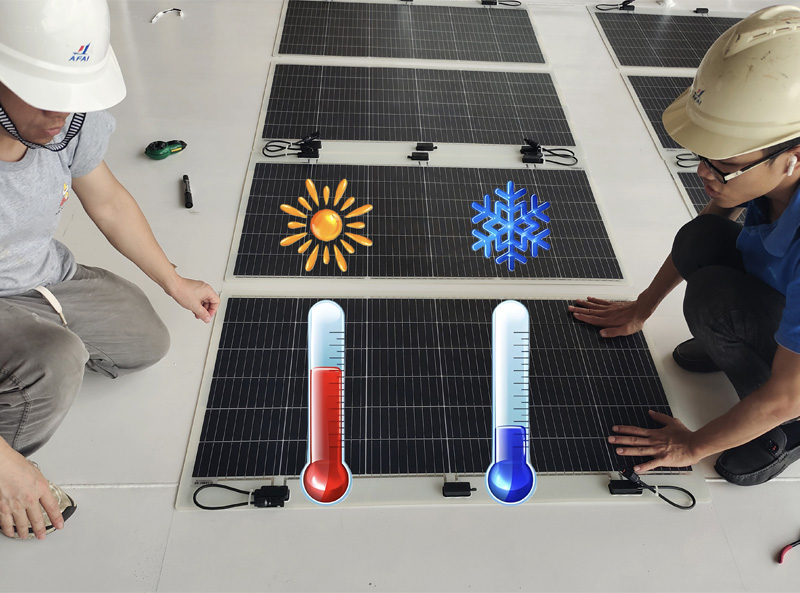
Solar panels perform best at moderate temperatures, with performance typically rated at 25 °C (77 °F) as a reference point. When the cell temperature rises above this nominal value, output efficiency usually decreases.
A common rule of thumb is that crystalline silicon panels lose roughly 0.3–0.5% of their power output for each 1 °C increase above 25 °C. On a very hot day (say panel surface reaching 60 °C), a silicon panel’s output might be 10–15% lower than its STC rating.
Key reasons for this inverse relationship include:
- Voltage Drop: The open-circuit voltage declines about 0.3–5% per °C, making it the primary driver of power loss.
- Bandgap Narrowing: Higher temperature reduces the semiconductor bandgap energy, increasing recombination losses.
- Series Resistance Increase: Electrical resistance in the cell and wiring rises with temperature.
- Slight Current Gain: Warmer panels produce a marginally higher short-circuit current, but this gain is too small to offset voltage losses.
The Best Temperature for Solar Panels
There is no “magic” optimal temperature beyond the laboratory standard. Panels are engineered so that 25 °C cell temperature is the reference efficiency point.
In general, panels achieve peak performance in moderate conditions, roughly 15–25 °C or 59–77 °F. At these temperatures, conversion efficiency is close to the rated values because voltage remains stable.
Cooler cells can perform even better, as lower temperatures increase voltage and marginally improve efficiency.
Operating Temperature Range of Solar Panels
Solar panels are robustly designed to handle wide temperature swings. Standard PV module specifications typically cover an extreme range of about –40 °C to +85 °C. In reality, panel cell temperatures often run 20–40 °C above ambient.
On a sunny summer day with 30 °C air temperature, a rooftop array might reach 50–70 °C. In winter, panels can tolerate deep cold and still function effectively within their tested operating limits.
Flexible solar panels, often made with lightweight polymer materials, also operate within similar ranges but can be more sensitive to prolonged high heat.
Their thinner encapsulation layers mean they heat and cool faster than rigid glass modules. This can be an advantage in moderate climates where quick cooling helps efficiency, but it also requires careful installation to avoid thermal stress in extreme environments.
Factors Influencing Temperature Effects
Several factors determine how hot a panel gets in operation and how much its efficiency is affected. Ambient conditions and solar irradiance set the baseline cell temperature.
The panel’s temperature coefficient indicates how sensitive it is to changes, while the underlying cell technology determines how it reacts to heat. Installation practices, such as mounting, ventilation, and color choices, influence how much heat accumulates or dissipates.
External factors like wind and airflow provide cooling, and overall system design, including tilt and tracking, shapes thermal performance.
| Factor | Description | Example/Notes |
| Ambient Conditions | Local climate sets the baseline cell temperature. | Hot desert regions push cell temperature up; cooler northern climates allow higher efficiency. |
| Solar Irradiance | Higher sunlight intensity raises panel temperature. | Midday summer sun increases heat load more than morning or evening sun. |
| Temperature Coefficient | Specifies how much efficiency decreases per °C, typically -0.3% to –0.5% for silicon modules. | A panel with –0.35%/°C loses 3.5% efficiency at 35 °C above STC. |
| Cell Technology | Different PV technologies respond differently; thin-film panels often have better thermal tolerance. | CdTe panels may have coefficients around –0.25%/°C compared to –0.45%/°C for crystalline silicon. |
| Mounting and Ventilation | Roof-mounted panels may trap heat, while rack-mounted arrays cool more easily. | Leaving a 6-inch gap under panels improves airflow and cooling. |
| Panel Color and Finish | Dark-colored backsheets or frames absorb more heat. | Black frames can run 2–3 °C hotter than silver frames. |
| Wind and Airflow | Natural breeze significantly reduces panel temperature. | Even 2 m/s wind can lower cell temperature by several degrees. |
| System Design | Tilt, orientation, and tracking systems influence both heating and cooling. | Vertical tilt can enhance airflow; trackers expose panels to more sun but often allow better cooling. |
Frequently Asked Questions
Q: What is the optimal operating temperature for solar panels?
A: Around 25 °C (77 °F) is ideal. Cooler improves efficiency slightly, hotter reduces it.
Q: Do solar panels work in very hot climates?
A: Yes, but efficiency declines. At 50–60 °C, power may be 10–15% below rating.
Q: How cold can solar panels operate?
A: Panels can operate down to –40 °C. Cold weather generally improves efficiency.
Q: Why do panels have a negative temperature coefficient?
A: Because voltage decreases with temperature rise, outweighing the slight current gain.
Q: Can cooling or ventilation improve performance?
A: Yes, spacing, airflow, and wind reduce heating and improve efficiency.
Q: Does heat shorten solar panel lifespan?
A: High operating temperature accelerates material aging, but quality panels are built and tested to last 25+ years even in hot climates.
Conclusion
Temperature has a direct, measurable effect on solar panel efficiency. Understanding coefficients, operating ranges, and thermal management strategies allows solar professionals to design systems that maintain reliable performance across diverse climates.
NEWLIGHT ENERGY are a trusted provider of solar panel and flexible solar panel solutions. Our products are engineered to deliver reliable performance, tailored to meet diverse environmental conditions and project requirements.
Partnering with us ensures access to high-quality technology, professional expertise, and solutions designed for long-term efficiency and sustainability.
--- END ---


