


News
Can You Walk on Flexible Solar Panels?
News | Oct 17,2025
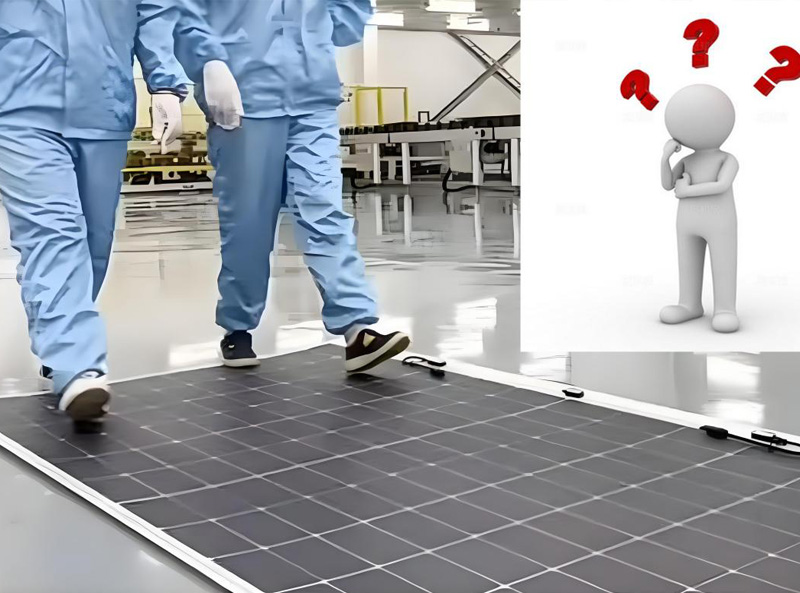
Semi-flexible solar panel really walk on?
In the market, some companies’ propaganda. Semi-flexible solar panels are designed to be walkable, but typically only when wearing soft-soled shoes and totally flat on the solar panel, it’s crucial to buy panels specifically marketed as “walkable” or “semi-rigid”.
These panels have a more robust construction, like analuminum backing and a tough, anti-skid ETFE surface, to protect against damage from foot traffic. Standard flexible panels can still be damaged by walking on them, so it’s important to choose the right type for your needs.
Key features of walkable semi-flexible panels
- Construction: They are reinforced with a strong backing(often aluminum) and are designed to be more robust than standard flexible panels.
- Surface: They have a thick, durable, and non-slip surface layer, such as ETFE, to protect against wear and tear from walking.
- Intended use: They are suitable for marine applications like boat decks, as well as camper van roofs, where regular foot traffic might occur.
Walk on Flexible Solar Panels, What Risks Are There?
Important considerations
- Footwear is critical: These panels are generally only meant to be walked on with soft-soled shoes. They will not withstand heavy work boots or grit, which can still cause damage.
- Potential for damage: Even with a “walkable” label, scuffing can reduce efficiency over time, and walking on them when they are hot from the sun will be very uncomfortable.
- Not for jumping or heavy loads: They are not built to handle jumping, impacts, or heavy work, though some are sturdy enough to have things piled on them or for light sitting.
- Installation: Proper installation is crucial for both safety and durability. They can conform to slightly curved surfaces but need a secure mounting to avoid shifting
Risks of walking on flexible solar panels
- Structural damage: Walking can cause micro-cracks in the solar cells and separate the layers of the panel, a process known as delamination.
- Reduced power output: Damage from walking can significantly decrease the panels’ energy production over time.
- Hotspots and fire risk: Internal damage from impacts can create hotspots, where sections of the panel get excessively hot, increasing the risk of a fire.
- Personal injury: Walking on panels, especially when wet, can lead to slips and falls.
- Compromised sealants: The sealants around the panels can be damaged, allowing moisture to get inside and cause further degradation.
Conclusion
Walked flexible solar panel is very strict, not only standard materials can afford, because monocrystalline solar cells are quite easy to be damaged when heavy weight is placed on there.
For us, if you are only accepting a walkable, flexible solar panel due to special installation surroundings, we do not recommend using semi semi-flexible solar panel with monocrystalline solar cell to make.
But prefer to use CIGS(Amorphous solar panel) to replace it, it is a really flexible solar panel.

--- END ---
Prev: How To Use Solar Battery Charger For Boat?
Next: Are Floldable Solar Panels The Best Solar Panels for Camping


