


News
Can a 400W Solar Panel Run a Refrigerator?
News | Mar 26,2026
How Much Power Does a Refrigerator Use?
The power consumption of a refrigerator is typically measured in two ways: Rated Power (instantaneous usage) and Actual Energy Consumption (total usage over time).
1. Instantaneous Power (Watts)
A typical household refrigerator uses between 100 and 800 Watts while the compressor is running.
- Mini Fridges: ~50W – 100W.
- Top-Freezer Models: ~100W – 400W.
- Side-by-Side/French Door Models: ~500W – 800W.
- Starting Power: Refrigerators require a “surge” of electricity to start the motor, which can be 2 to 3 times higher than their rated power (e.g., a 700W fridge may spike to 2,200W for a split second).
2. Actual Energy Consumption (kWh)
Because a refrigerator cycles on and off (typically running only 6 to 8 hours a day), it doesn’t use its full wattage 24/7.
- Daily Average: Most modern, efficient refrigerators consume between 1 and 2 kWh per day.
- Annual Average: Standard units usually range from 300 to 1,460 kWh per year.
3. Key Factors Affecting Consumption
- Efficiency Rating: ENERGY STAR-certified models are about 9% more energy-efficient than standard models.
- Ambient Temperature: Placing a fridge near an oven, heater, or in direct sunlight forces the compressor to work harder, increasing power use.
- Usage Habits: Frequent or long door openings allow cold air to escape. Keeping the fridge 70-80% full (not empty, but not overstuffed) helps maintain a stable temperature.
- Maintenance: Dust on condenser coils reduces cooling efficiency. Cleaning them every six months can improve efficiency by up to 15%.
4. How to Find Your Fridge’s Power Usage
- Check the EnergyGuide Label: Look for the bright yellow tag on the unit; it lists the estimated yearly energy cost and kWh.
- Read the Nameplate: Find the sticker inside the fridge wall or on the back. If it only lists Volts (V) and Amps (A), use the formula: Volts × Amps = Watts.
How Much Power Does a 400W Solar Panel Produce?
A standard 400W solar panel has a peak power output of 400 watts under ideal conditions (Standard Test Conditions: irradiance of 1000W/m², temperature of 25°C).
However, in practical daily use, the electrical energy (kilowatt-hours, kWh) it generates is more critical—and this depends primarily on your location’s average daily effective sunshine hours.
Daily Power Generation Estimation
The daily output of a 400W solar panel can be estimated using this formula:
Below is a reference table for different sunshine conditions:
| Your Location’s Sunshine Type | Average Daily Effective Sunshine Hours (Reference) | Estimated Daily Power Generation of a Single 400W Panel |
| Sunny Regions | 5 – 6 hours | 2.0 – 2.4 kWh |
| Moderate Sunshine Regions | 4 – 5 hours | 1.6 – 2.0 kWh |
| Low Sunshine Regions | 3 – 4 hours | 1.2 – 1.6 kWh |
Key Influencing Factors
- Sunshine Intensity and Duration: The most critical factor (as reflected in the table above).
- Installation Angle and Orientation: Optimal annual output is typically achieved when panels face due south with an inclination angle equal to the local latitude.
- Ambient Temperature: Panel efficiency decreases slightly in high temperatures.
- Shading and Cleanliness: Obstructions (trees, buildings) or dirt/snow on the panel surface will significantly reduce output.
Can a 400W Solar Panel Run a Refrigerator?
Here’s the breakdown:
1) Energy Match (Theoretically Possible)
- Refrigerator Need: Uses about 1–2 kWh per day.
- 400W Panel Output: Generates about 1.2–2.4 kWh per day (with 3–6 hours of good sun).
- Conclusion: In a sunny location, the daily energy produced by one panel can cover the daily energy needs of an efficient refrigerator.
2) The Critical Limitations (Why “Yes, but…”)
You can not simply plug a fridge into a solar panel. Three major issues prevent this from working directly:
- Intermittent Power: The panel only produces power during sunny daylight hours. The refrigerator needs to run 24/7.
- No Storage: Without a battery, there is no energy to run the fridge at night or on cloudy days.
- Power Conversion: Refrigerators run on alternating current (AC). Solar panels and batteries output direct current (DC), requiring an inverter.
3) Required System Components
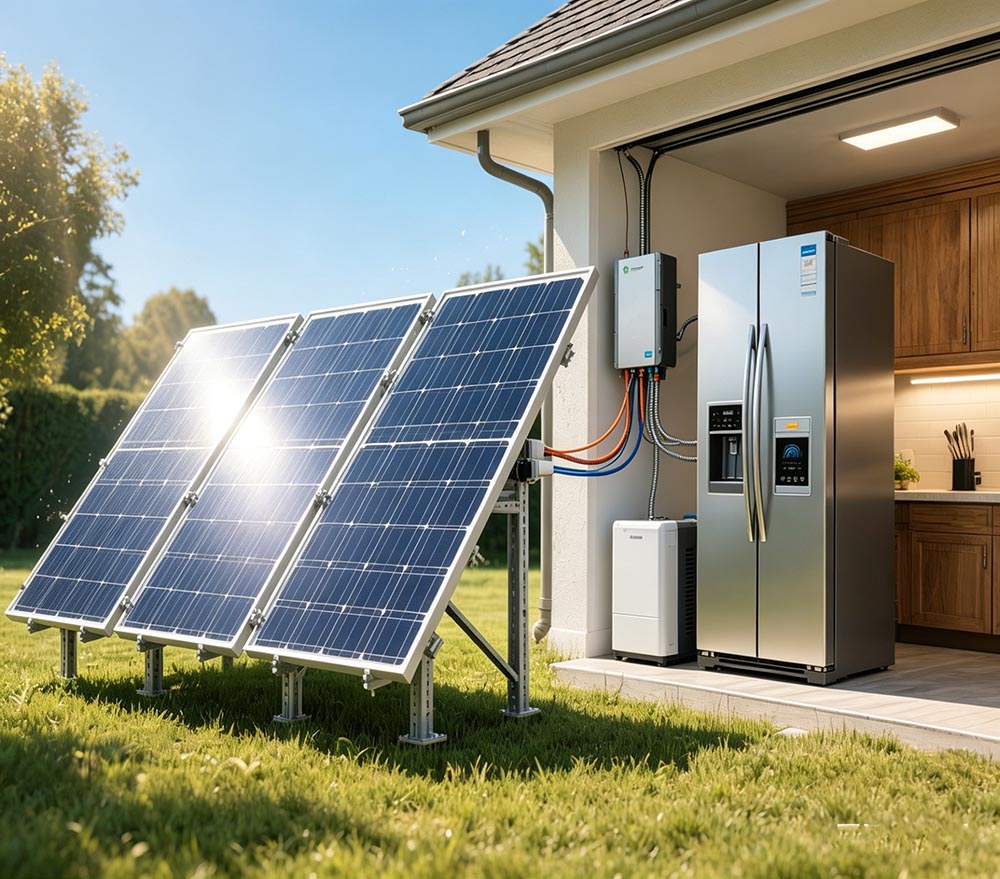
To make it work, you need a complete off-grid solar system:
- Solar Panel(s): The 400W panel.
- Charge Controller: Regulates the power from the panel to the battery.
- Battery Bank (Essential): Stores the solar energy for use anytime. You’d need a battery with at least 2–3 kWh of usable capacity.
- Inverter: Converts the battery’s DC power to AC for the fridge. It must be rated for the refrigerator’s starting surge (often 3-5 times its running wattage).
- Practical Answer: A single 400W panel is often the minimum starting point.
For reliable year-round operation, especially in less sunny areas or for larger fridges, 2 panels are commonly recommended. This provides a buffer for cloudy days and system losses.
Why You Need More Than Just a Solar Panel
Need more than just a solar panel because a panel alone cannot provide continuous, usable power for appliances like a refrigerator.
Here’s why in three key gaps:
1) The Time Gap – No Sun, No Power
Solar panels only produce electricity when the sun is shining. Appliances need to run day and night. Without a way to store energy for nighttime or cloudy days, power stops when the sun sets.
2) The Storage Gap – No Battery, No Reserve
Energy must be stored for when it’s needed. A battery acts like a “power bank,” storing solar energy during the day so you can use it anytime. Without a battery, excess energy generated midday is wasted.
3) The Compatibility Gap – Wrong Current Type
- Solar panels and batteries output Direct Current (DC).
- Most household appliances (including refrigerators) require Alternating Current (AC).
- An inverter is essential to convert DC to usable AC power.
Additionally, appliances like refrigerators have a high starting surge that a panel alone cannot handle—a battery and an inverter are needed to deliver that instant power.
Bottom line: A solar panel is only the energy source. To get reliable, on-demand electricity, you need a full system: Panel → Charge Controller → Battery → Inverter → Appliance.
How Many Solar Panels Do You Actually Need?
The number of solar panels you actually need depends on three key factors: your daily energy consumption, your local sunlight hours, and the wattage of the panels.
Here’s how to calculate it.
1) Core Calculation Formula
Number of Panels ≈ (Daily Energy Use in kWh) ÷ (Effective Sunlight Hours) ÷ (Panel Wattage in kW)
Let’s break it down with a refrigerator example:
Step 1: Find Your Appliance’s Daily Energy Use
- A modern fridge uses about 1–2 kWh per day.
- Check your fridge’s energy label or manual for the exact “kWh per year” and divide by 365.
Step 2: Determine Your Local “Effective Sunlight Hours”
- This is not daylight hours, but the equivalent hours of peak sun.
- Example averages: Arizona ~5.5 hrs, New York ~4 hrs, UK ~2.5 hrs.
- You can find maps or databases for your specific location.
Step 3: Do the Math
- Scenario: You need 2 kWh/day, live where you get 4 peak sun hours, and use 400W (0.4 kW) panels.
- Calculation: 2 kWh ÷ 4 hrs ÷ 0.4 kW = 1.25 panels.
- Result: You would need 2 panels in practice (always round up).
2) Critical Real-World Adjustments
The simple formula gives a minimum.
You must add buffers for:
- System Losses (inverter, wiring, dirt): Add 20-30% more capacity.
- Battery Efficiency: If storing power, add 10-20% to account for charging/discharging losses.
- Future Expansion & Bad Weather: For reliability, it’s common to oversize the array by 25-50%.
Adjusted Calculation:
- 2 kWh/day ÷ 4 hrs ÷ 0.4 kW = 1.25 panels
- Add 30% for losses: 1.25 × 1.3 ≈ 1.63 panels
- Round up for reliability: 2 panels minimum, 3 would be more robust.
3) Quick Reference Table (For 400W Panels)
| Daily Energy Need (kWh) | Sunny Area (5.5 hrs) | Moderate Area (4 hrs) | Less Sunny Area (2.5 hrs) |
| 1.5 kWh (Efficient Fridge) | 1 panel | 1-2 panels | 2 panels |
| 3 kWh (Fridge + Lights/Phone) | 2 panels | 2-3 panels | 3-4 panels |
| 10 kWh (Basic Home Load) | 5 panels | 7 panels | 10 panels |
In summary: For just a refrigerator, you typically need 2-3 standard 400W panels in a moderately sunny climate after accounting for real-world factors. For a whole house, a detailed energy audit is essential.
Best Use Cases for a 400W Solar Panel
The best use cases for a single 400W solar panel are for small-scale, off-grid applications where it’s paired with a battery system. It’s an excellent entry point for portable power, emergency backup, and reducing reliance on the grid for specific devices.
Here are the most practical and effective uses:
1) Powering a Dedicated Appliance
Modern Refrigerator/Freezer: A primary use case. With a proper battery-inverter setup, one 400W panel can often cover the daily needs of an efficient fridge, making it ideal for cabins, sheds, or as a dedicated backup for food preservation.
- RV/Boat Power: Perfect for keeping lights, water pumps, fans, and small electronics running while off-grid.
- Workshop or Garden Shed: Provides clean power for lighting, battery chargers for tools, or a small ventilation fan.
2) Portable & Recreational Power
- Overlanding & Camping: Paired with a portable power panel (solar generator), it can recharge phones, cameras, drones, laptops, and run a portable fridge or LED lights indefinitely in sunny weather.
- Van Life: A core component of a van’s electrical system to maintain house batteries for daily essentials.
3) Emergency Preparedness & Backup
- Critical Communications: Keeps phones, radios, and satellite communicators charged during a grid outage.
- Essential Lighting: Powers efficient LED lights at night when stored in a battery.
- Medical Devices: Can be part of a system to run or recharge critical low-wattage medical equipment (always with professional consultation and redundancy).
4) Supplemental Grid-Tied Use (Niche)
- “Plug-and-Play” System: In some regions, you can use a micro-inverter to directly feed a small amount of solar into a household outlet, offsetting the “phantom load” from devices like internet routers, TVs on standby, and cable boxes.
- Dedicated Circuit: Wire it (with a professional) to directly offset the energy use of a single, constant load like a well pump or attic fan.
XM NewlightEnergy Solar Solutions for Appliance Power
If you need a portable for travel, the folding solar panel series good choice https://www.xmnewlight.com/category/foldable-solar-panel/
If you need a power home system, XM Newlight Energy provide whole home solar power system solutions.

--- END ---


