


News
Why Your Solar Light Poles Keep Dying (And How to Prevent It)
News | Apr 27,2026
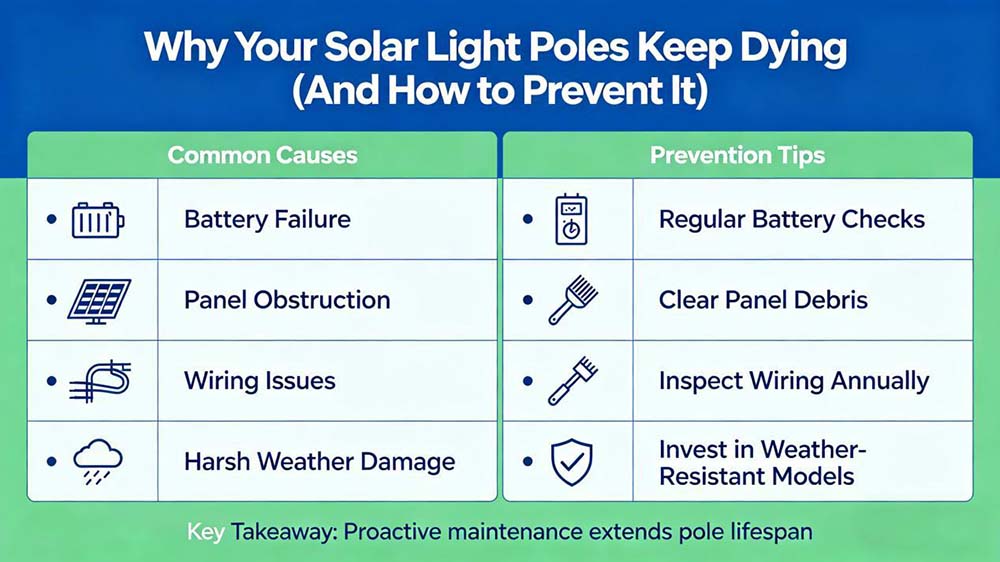
Solar light poles are a fantastic, eco-friendly, and cost-effective solution for illuminating streets, parking lots, parks, and commercial facilities. They operate independently of the grid, saving on energy costs and trenching fees. However, there is nothing more frustrating than investing in outdoor lighting only to have it dim, flicker, or die entirely after just a few months of operation.
If you are dealing with solar street lights or light poles that constantly fail prematurely, you are not alone. This guide explains the fundamental technology behind these systems and the most common reasons for failure to help you ensure your next lighting project remains reliable for years to come.
Understanding Solar Light Technology
To identify why a solar light pole might fail, it is essential to understand the four primary components that work in harmony. The solar panel acts as the power plant, converting sunlight into electricity during the day. This energy is managed by a charge controller, which directs the power into a high-capacity battery for storage. Once the sun sets, the controller recognizes the drop in voltage and triggers the LED fixture to draw power from the battery.
A failure in any one of these components, or a mismatch in their specifications, will lead to a system-wide breakdown. Commercial-grade solar light poles are engineered with precise calculations to ensure that the energy harvested during the day is sufficient to power the LEDs throughout the night, even during seasons with shorter daylight hours.
Top 5 Reasons Solar Light Poles Fail Prematurely

Now that we understand how the system is supposed to work, we can examine where things typically go wrong. Below are the most frequent causes of solar lighting failure and how you can avoid them.
1. Degraded or Low-Quality Battery Performance
The battery is the most critical part of any solar light pole. Many lower-end solar lights use cheap lead-acid or low-grade lithium batteries that degrade quickly, especially in areas with extreme temperature fluctuations. Once a battery loses its capacity to hold a charge, the light will turn off just a few hours after sunset or fail to turn on at all. When sourcing solar light poles, it is vital to look for systems that utilize high-quality LiFePO4 (Lithium Iron Phosphate) batteries. These batteries offer superior thermal stability and a much deeper depth of discharge.
2. Strategic Placement and Shading Issues
Even the most advanced solar light pole cannot function if it does not receive adequate sunlight. Solar panels require direct and unobstructed sunlight to charge the battery fully. If light poles are installed beneath heavy tree canopies, tucked next to tall buildings, or placed in areas that are shaded for most of the day, the battery will consistently undercharge. This chronic undercharging leads to a “sulfation” effect in some batteries or general capacity loss in others, permanently damaging their lifespan. Proper site planning ensures poles are installed in open areas to capture maximum solar radiation.
3. Regular Cleaning and Surface Maintenance
A solar light pole is an outdoor fixture constantly exposed to the elements. Over time, a layer of dust, dirt, pollen, bird droppings, or snow can accumulate on the surface of the solar panel. This debris acts as a physical barrier that blocks UV rays from reaching the photovoltaic cells, which severely reduces the charging efficiency of the panel. Implementing a routine maintenance schedule to wipe down the solar panels with a soft cloth can dramatically improve their charging capacity and extend the life of the entire unit.
4. Superior Weatherproofing and IP Ratings
Outdoor lighting must be built to withstand rain, snow, humidity, and high winds. Cheaply manufactured solar lights often have poor seals around the LED housing, the battery compartment, or the solar controller. When moisture seeps into these sensitive areas, it causes corrosion and short circuits the wiring. Before purchasing, you should always verify the Ingress Protection (IP) rating. For commercial outdoor applications, the fixture should have an IP65 or IP67 rating to ensure it is completely dust-tight and resistant to heavy rain and water jets.
5. Advanced Engineering and Heat Dissipation
The difference between a consumer-grade light and a commercial-grade street light is often found in the internal engineering. Low-cost units frequently use subpar charge controllers and thin plastic housings that do not manage heat effectively. High-output LEDs generate significant heat, and if the light fixture lacks a proper aluminum heat sink, the LEDs will overheat. This leads to a rapid loss of brightness and eventual total failure. Investing in solar light poles constructed with heavy-duty aluminum alloys and MPPT (Maximum Power Point Tracking) controllers is essential for long-term durability.
Quality Matters for Longevity
When a solar light pole dies prematurely, it is usually the result of compromised component quality or improper installation. While cheaper solar lights might seem like a bargain initially, the continuous cost of replacing batteries and repairing water-damaged fixtures quickly negates any initial savings.

If you are looking for reliable, commercial-grade lighting solutions that are built to last, explore our premium selection of Solar Light Poles at Xmnewlight We prioritize high-capacity LiFePO4 batteries, robust weatherproofing, and high-efficiency solar panels so your outdoor spaces stay safely illuminated night after night.
--- END ---
Prev: The Best Portable Solar Panels of 2026
Next: The 2026 Playbook for Off-Grid Solar: Uncomplicating Your Power Setup


