


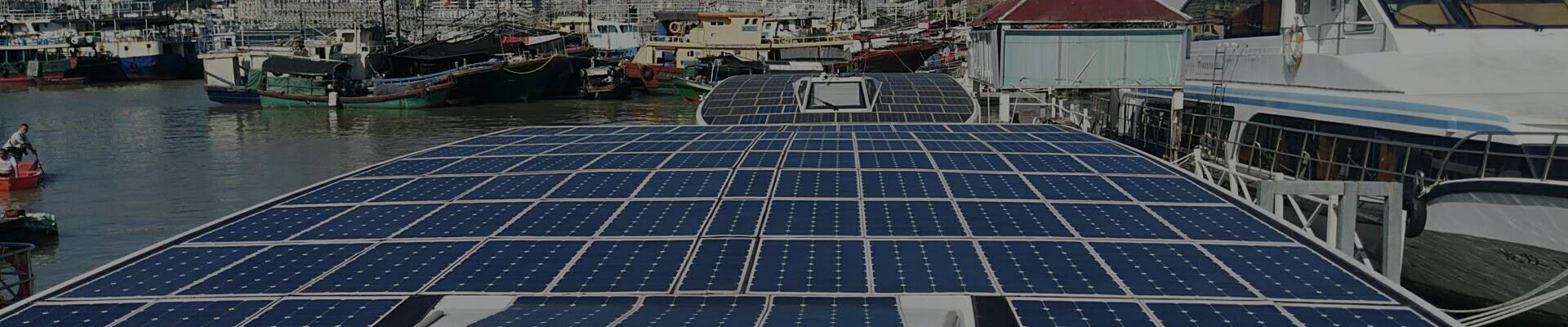
What Are Flexible Solar Panels and How They Work in Solar Lighting
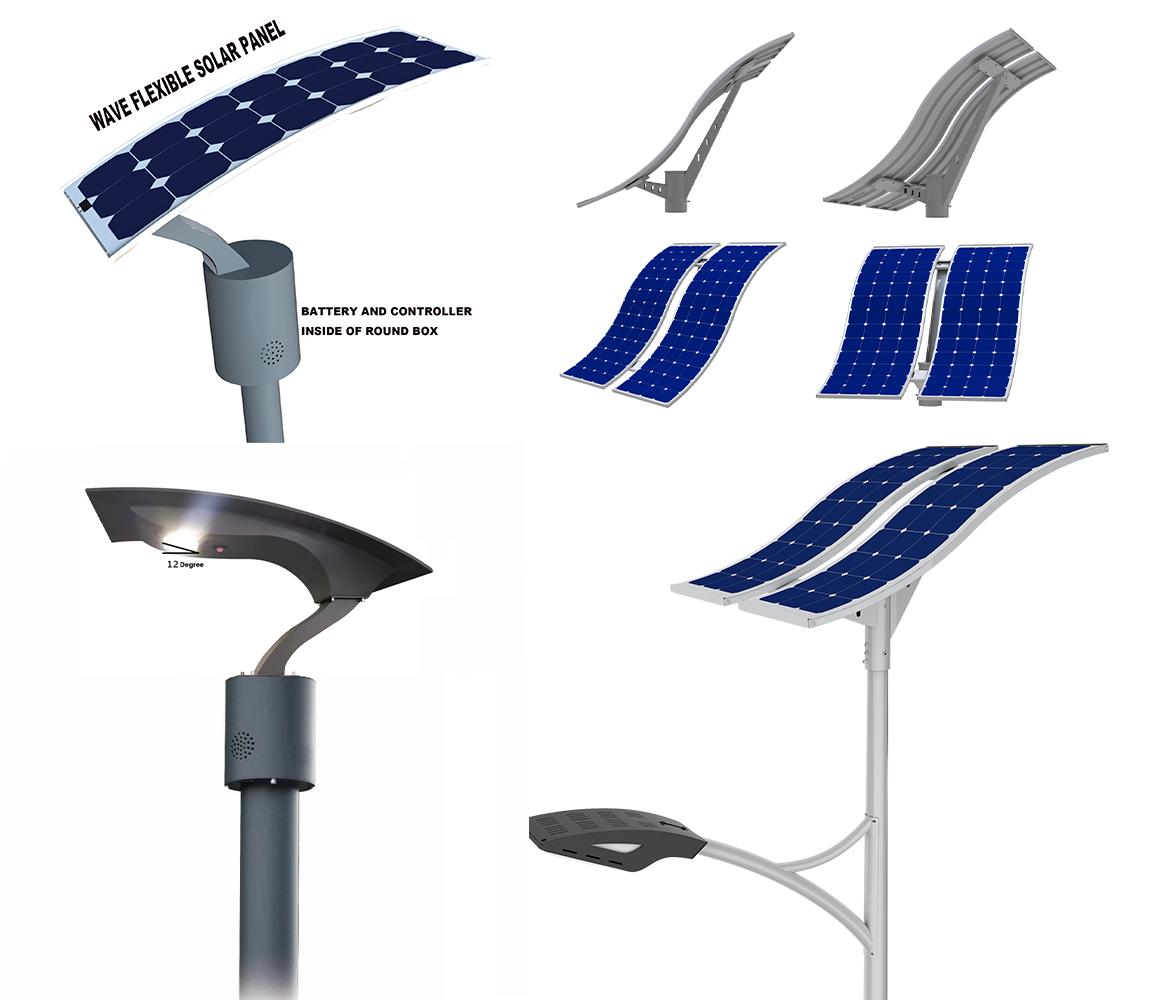
Flexible solar panels are thin, lightweight photovoltaic modules that can bend to conform to curved or irregular surfaces. Unlike traditional glass-encapsulated rigid panels, flexible panels use polymer substrates and advanced encapsulation materials to achieve remarkable adaptability — some can bend to a radius as tight as 30 degrees without performance degradation.
In solar lighting applications, flexible panels have transformed what is possible in product design. Their ability to wrap around poles, integrate into light fixture housings, and conform to aerodynamic shapes has opened new avenues for architects, engineers, and product designers who previously had to compromise aesthetics for solar functionality.
How Flexible Solar Panels Work in Solar Lighting
The operating principle is identical to rigid solar panels — photovoltaic cells absorb photons and generate direct current electricity through the photovoltaic effect. The difference lies in the construction:
- Instead of a rigid glass front sheet and aluminum frame, flexible panels use a thin polymer front sheet (ETFE) that allows the entire assembly to bend.
- The solar cells themselves are either ultra-thin monocrystalline wafers (typically 80–150 micrometers thick) or thin-film CIGS cells deposited directly onto a flexible substrate.
- A flexible backsheet replaces the standard glass-backsheet construction, reducing weight by 70–80% compared to an equivalent rigid panel.
- In solar lights, the flexible panel feeds a charge controller connected to a battery pack. At dusk, the controller activates the LED light, drawing power from the stored energy.
Types of Flexible Solar Panels
The flexible solar panel market has evolved into three distinct technologies, each with unique characteristics that suit specific solar lighting applications.
Monocrystalline Flexible Panels (PERC)
The dominant technology in the premium solar lighting segment. Ultra-thin monocrystalline silicon wafers (p-type or n-type) are embedded in a flexible polymer laminate. Efficiency: 20–23%, making them the highest-performing flexible option.
Best suited for: Solar street lights, commercial solar lighting, and any application where space is limited and maximum power per square meter is required. Their higher efficiency means a smaller panel can generate the same power as a larger, lower-efficiency alternative — a critical advantage in space-constrained lighting fixture designs.
CIGS (Copper Indium Gallium Selenide) Thin-Film Panels
CIGS panels use a thin-film semiconductor deposited directly onto a flexible substrate (stainless steel foil or polyimide). Efficiency: around 18%. The key differentiator is exceptional flexibility — CIGS cells can bend to tighter radii than crystalline silicon and are virtually unbreakable.
Best suited for: Curved surface integration, cylindrical poles, architectural lighting with tight radius requirements, and applications where impact resistance is paramount. CIGS panels are the preferred choice for Solar Wrap systems that conform to cylindrical or hexagonal pole geometries.
Flexible vs. Rigid Glass Panels — Wave Solar Light Design Trade-Offs for Solar Light Manufacturers
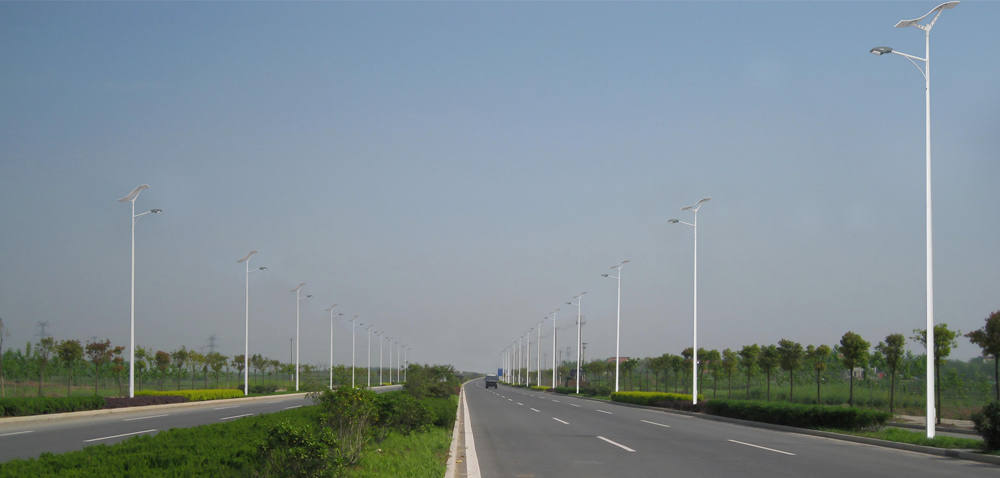
Flexible Solar panel for wave solar street light
Choosing between flexible and rigid glass solar panels for a lighting product is one of the most consequential design decisions a manufacturer can make. Each technology brings distinct advantages and compromises that must be weighed against the specific application requirements.
Weight Comparison
A standard 100W rigid glass panel weighs approximately 7–8 kg. An equivalent flexible panel weighs 1.5–2.5 kg — a 70–80% reduction. In solar lighting, this weight saving has profound implications: lighter poles, simpler mounting structures, reduced shipping costs (by up to 40% on container freight), and easier installation without heavy lifting equipment.
Durability and Impact Resistance
Rigid panels with tempered glass can withstand hailstones up to 25 mm diameter at 80 km/h. However, tempered glass can shatter under concentrated point impacts (e.g., a thrown rock). Flexible panels are inherently unbreakable — they can be walked on, dropped, and struck without cracking. ETFE-laminated flexible panels resist puncture and tear. For solar lights installed in public areas, vandalism-prone locations, or coastal environments where salt corrosion attacks aluminum frames, flexible panels offer superior survivability.
Heat Dissipation
Rigid panels benefit from a rear air gap that allows heat to dissipate naturally, keeping cell temperatures 10–25°C lower than the ambient air temperature. Flexible panels mounted directly onto surfaces trap heat, increasing cell temperature and reducing efficiency by 0.3–0.5% per degree Celsius above 25°C. This is why proper ventilation — even a 3–5 mm air gap — is critical for flexible panel performance in solar lighting applications.
Aesthetic Integration
Flexible panels win decisively on aesthetics. A rigid panel must be mounted above or beside the light fixture, creating a distinctive “solar panel on a stick” appearance. Flexible panels can be seamlessly integrated into the fixture design — wrapped around a pole, embedded in a lamp head, or concealed within an architectural element. For design-conscious municipal projects, heritage streetscapes, and premium architectural lighting, flexible panels enable a level of visual integration that rigid panels cannot achieve.
Cost per Watt
Rigid glass panels benefit from decades of manufacturing scale, achieving costs as low as $0.10–$0.15 per watt. Flexible panels currently cost $0.30–$0.60 per watt — 2–4 times more. However, when total system cost is considered (simpler mounting, reduced shipping, lighter poles), the system-level cost difference narrows significantly. For integrated solar lighting products, the cost premium of flexible panels is often offset by savings in structural materials and installation labor.
4. Key Performance Metrics: Efficiency, Power Output, and Bend Radius
Understanding the technical specifications of flexible solar panels is essential for selecting the right product for a given solar lighting application. Three metrics dominate the decision:
Conversion Efficiency
Efficiency measures what percentage of sunlight striking the panel is converted into usable electricity. This is the single most important metric for space-constrained solar light designs:
- Monocrystalline PERC flexible: 23–24% — The current standard for premium solar lighting
- CIGS thin-film: 18% — Lower efficiency but superior flexibility and low-light performance, best for solar cylindrical wrap
For a given light output requirement, a higher-efficiency panel can be 20–40% smaller than a lower-efficiency alternative. In product design, this translates to more compact, lighter, and often more attractive fixtures.
Power Output (Wattage)
Panel wattage determines how much energy is available to charge the battery. The appropriate wattage depends on the LED power and desired runtime:
- 5–15W: Garden lights, pathway lights, and decorative solar lighting
- 20–50W: Residential security lights, bollard lights, and commercial garden lighting
- 50–150W+: Commercial solar street lights, parking lot lighting, and municipal projects
A common rule of thumb: the solar panel wattage should be 1.5–2.5 times the LED wattage to ensure adequate charging even on partially cloudy days.
Bend Radius
Bend radius describes how tightly a flexible panel can be curved without damage — measured as the minimum radius the panel can safely conform to:
- Monocrystalline flexible: Minimum bend radius of 200–500 mm (depends on cell layout)
- CIGS thin-film: Minimum bend radius as tight as 30–50 mm — orders of magnitude more flexible
5. How to Select the Right Solar Panel Type for Different Solar Light Applications
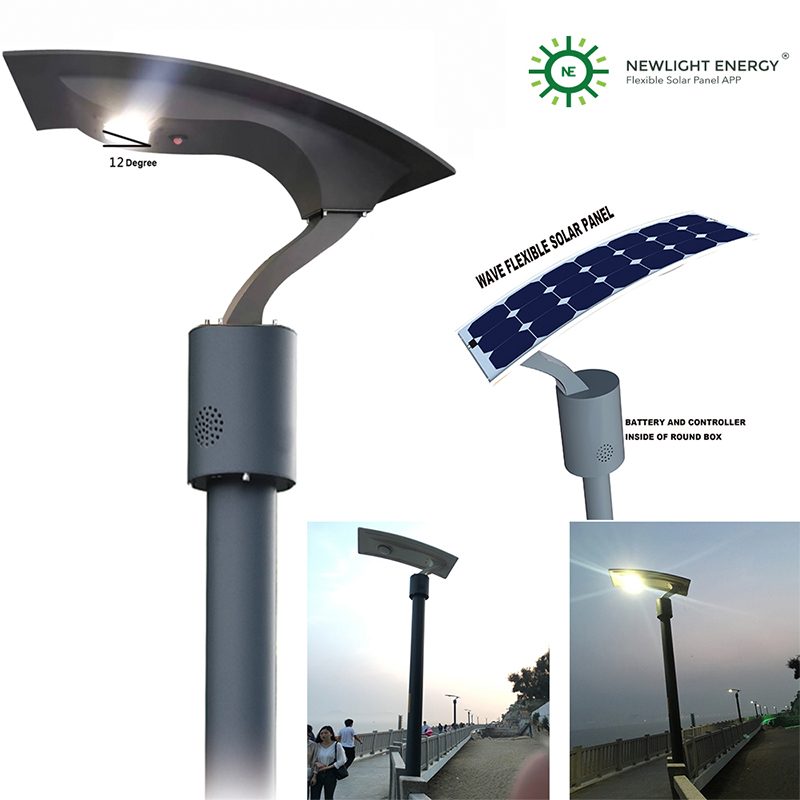
Wave Solar Garden Light — Semi-flexible monocrystalline panel integrated into a compact garden light design.
Selecting the optimal solar panel technology for a lighting product requires matching panel characteristics to application demands. The following framework guides the decision:
Solar Street Lights — Commercial and Municipal
- Recommended: Monocrystalline PERC flexible (20–23%)
- Wattage: 80W–150W+ for standard street light applications
- Rationale: Space is constrained on a street light pole; maximum power per square meter is critical. The efficiency premium of monocrystalline panels justifies the cost in commercial applications where reliability and performance are non-negotiable. For pole-integrated designs (Solar Wrap), segmented monocrystalline panels or CIGS panels are specified.
Solar Garden and Pathway Lights
- Recommended: Monocrystalline PERC flexible (20–23%) for premium; a-Si (6–10%) for budget
- Wattage: 5–15W
- Rationale: Garden lights have smaller batteries and lower LED power, so panel efficiency is less critical. The compact size of garden lights favors flexible panels that can be integrated into the fixture head. For budget-focused residential products, a-Si panels offer adequate performance at lower cost.
Solar Flood Lights — Security and Area Lighting
- Recommended: Monocrystalline PERC flexible (23–24%)
- Wattage: 20–50W
- Rationale: Flood lights require reliable charging to support motion-activated high-power modes. The separate panel configuration (panel mounted remotely from light) means panel size is not constrained by the fixture — but efficiency still matters for charging speed.
Solar Bollard Lights
- Wattage: 3–20W
- Rationale: Bollard lights have a vertical cylindrical form factor that naturally suits CIGS wrap panels. The ability to curve the panel around the bollard body creates a clean, integrated appearance. CIGS panels are rugged enough to withstand occasional impacts from lawn equipment and foot traffic.
Architectural and Decorative Solar Lighting
- Recommended: PERC Semi-flexible (23–24%) for premium; CIGS (18%) for curved surfaces on cylindrical design
- Wattage: 5–20W
Maintenance and Lifespan Optimization for Flexible Panel Solar Lights
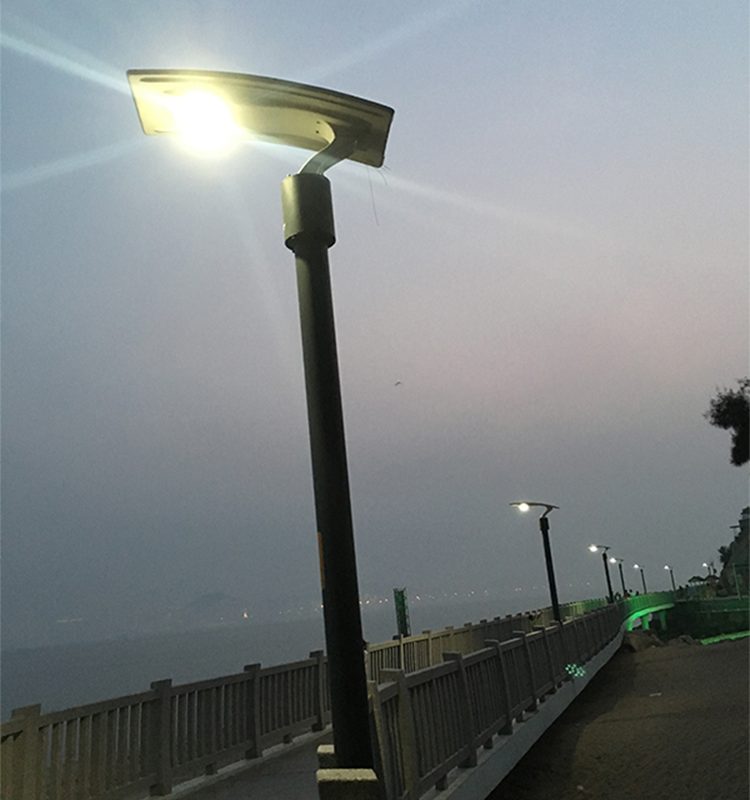
Wave Solar Garden Light at Night — Proper maintenance ensures consistent performance through changing seasons.
Flexible panel solar lights require less maintenance than wired alternatives, but attention to a few critical areas can significantly extend their useful life.
Panel Cleaning
Dust accumulation on flexible panels reduces charging efficiency by 5–30% depending on local conditions. Clean panels every 2–3 months with a soft cloth and mild soapy water. Avoid abrasive cleaners that can scratch the ETFE or PET surface. In dry, dusty climates, monthly cleaning is recommended. In rainy climates with at least 25 mm of monthly rainfall, natural rain cleaning may be sufficient except during dry spells.
Battery Replacement Schedule
The battery is the first component to reach end-of-life in any solar light:
- Standard lithium-ion: Replace every 2–4 years
- Lithium iron phosphate (LiFePO₄): Replace every 5–8 years
- Nickel-metal hydride (NiMH): Replace every 1–2 years
Plan battery replacement proactively rather than waiting for the light to fail. A battery that has lost 30% of its original capacity will cause the light to dim noticeably in the second half of the night.
Connection and Seal Inspection
Annually inspect all connections and seals:
- Check that panel-to-controller wiring connections are clean, dry, and free of corrosion
- Verify that battery terminal connections are tight and free of white/green corrosion deposits
- Inspect all gaskets and O-rings for cracking, hardening, or compression set — replace any that show wear
- Confirm that all screw caps, cable glands, and compartment covers are fully tightened
Seasonal Adjustments
In regions with significant seasonal variation in sun angle:
- If the panel is adjustable (separate panel or tilting bracket), adjust the tilt angle seasonally: shallower in summer (20–30° from horizontal), steeper in winter (45–60°)
- Clear snow from panels promptly after storms — even 2 cm of snow can block 100% of charging
- Trim back vegetation that may have grown to shade the panel — a plant that was below the panel in spring may cast shade by late summer
XM Newlight Flexible Solar Panel Lighting Solutions
Wave Solar Light Series — Integrated Flexible Panel Lighting
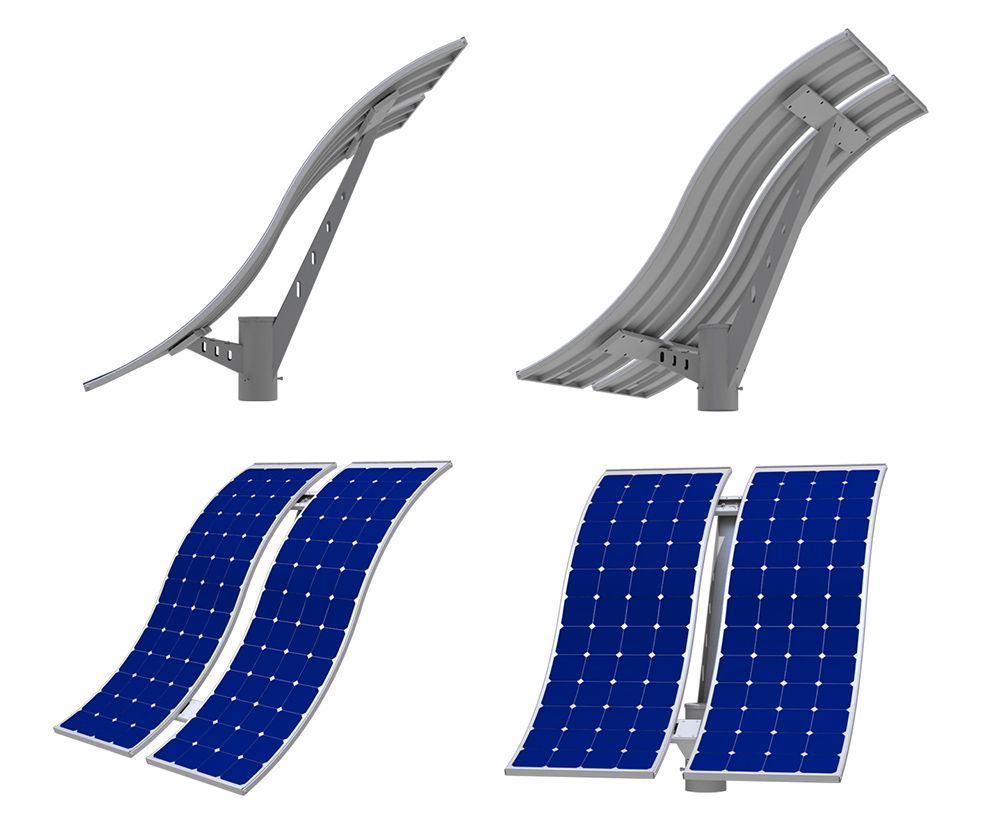
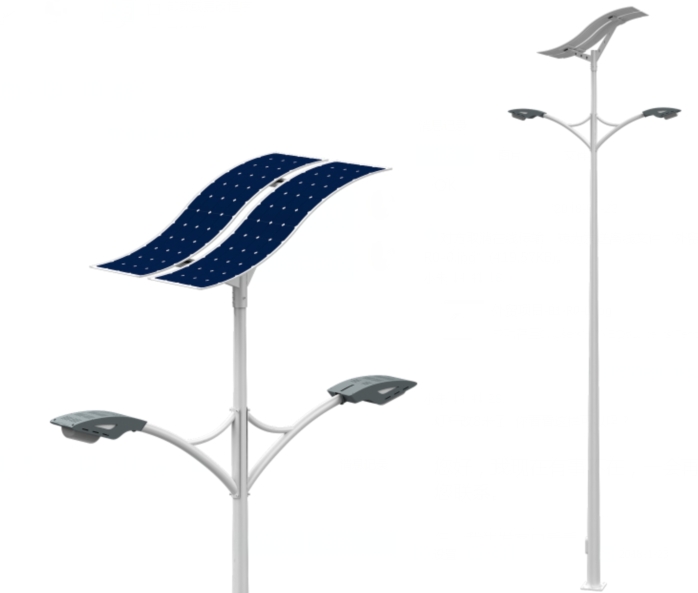
The Wave Solar Light series combines a semi-flexible monocrystalline solar panel with high-output LED lighting in a single, weatherproof unit. Available in configurations from 15W garden lights to 100W street lights, good for governmental and municipality projects.
- Semi-flexible monocrystalline solar panel (23–24% efficiency) bonded to the fixture housing
- LiFePO₄ battery with 2,000+ charge cycles and 5–8 year service life
- MPPT charge controller for maximum energy harvest in varying light conditions
- PIR motion sensor with intelligent dimming for energy conservation
- Dusk-to-dawn photocell with optional programmable scheduling
- IP65 weatherproof construction with ETFE-laminated panel
- 15W garden light to 100W street light models available
Frequently Asked Questions
What type of flexible solar panel is best for solar street lights?
Monocrystalline PERC flexible panels (23–24% efficiency) are the best choice for most solar street lights because they offer the highest power density per square meter. For pole-integrated designs requiring tight curvature around cylindrical or hexagonal poles, CIGS thin-film panels (18% efficiency) are preferred due to their superior flexibility.
Are flexible solar panels durable enough for outdoor use?
Yes. ETFE-laminated flexible panels are UV-resistant, waterproof, and designed for more than 10 years of outdoor use. The ETFE top sheet resists yellowing and maintains >95% light transmission for a decade or more. Combined with IP65+ rated housings and silicone gaskets, quality flexible panel solar lights routinely achieve more than 10 years service lives in real-world municipal installations.
Do flexible solar panels need ventilation?
Yes. While flexible panels can be mounted directly to surfaces, providing a small 3–5 mm air gap behind the panel reduces operating temperature by 10–15°C and improves charging efficiency by 3–6%. If the panel must be mounted directly to a surface (as in some integrated designs), a metal backing plate or thermally conductive adhesive can improve heat dissipation. XM Newlight Solar Wrap systems incorporate aluminum mold frames that act as both structural support and heat sinks.
What wattage flexible solar panel do I need for my solar light?
Panel wattage should be matched to the LED power and desired runtime:
- 5–15W: Garden lights, pathway lights, and decorative solar lighting
- 20–50W: Residential security lights and commercial garden lighting
- 50–150W+: Commercial solar street lights, parking lot lighting, and municipal projects
As a general guideline, the solar panel wattage should be 1.5–2.5 times the LED wattage to ensure adequate charging during periods of suboptimal sunlight.
Can flexible solar panels be used on curved or cylindrical light poles?
Yes — this is one of the primary advantages of flexible solar panels. Monocrystalline flexible panels can conform to gentle curves (minimum bend radius 200–500 mm), while CIGS thin-film panels can wrap around tight-radius cylinders (minimum bend radius as low as 30 mm). XM Newlight Solar Wrap systems are specifically designed for cylindrical, square, hexagonal, and triangular pole geometries, offering custom-manufactured panels that match any pole cross-section.
How long do flexible solar panels last in solar light applications?
With proper selection and maintenance: ETFE-laminated monocrystalline flexible panels typically maintain >80% of original power output for 10–15 years. CIGS thin-film panels have similar longevity. The panel itself is rarely the failure point in a well-designed solar light — the battery and electronic controller typically reach end-of-life first (8-10 years for LiFePO₄).
Are flexible solar panels more expensive than rigid panels?
On a cost-per-watt basis, yes — flexible panels cost approximately 2–4 times more than equivalent rigid glass panels ($0.30–$0.60/W vs. $0.10–$0.15/W). However, when evaluated at the system level for solar lighting products, the cost difference narrows significantly. Flexible panels eliminate the need for separate mounting structures, reduce pole requirements (lighter panels = lighter poles), simplify installation (no heavy equipment needed), and lower shipping costs (70–80% lighter). For integrated solar lighting products, the total system cost premium of flexible panels is typically 10–25%, justified by superior aesthetics, simplified installation, and reduced structural requirements.
What certifications should I look for in flexible solar panels for lighting?
For international projects, look for: (1) CE marking — mandatory for European Union market access; (2) RoHS compliance — restricts hazardous substances; (3) IP rating certificate — verifies weather resistance claims; (4) IES/LM-80 photometric testing — for LED light output verification; (5) IEC 61215 — design qualification for solar panels; (6) UL listing — required for US market; (7) ISO 9001 — manufacturer quality management system. XM Newlight products are CE, RoHS, and IP rated, with third-party test reports available upon request.
Can XM Newlight manufacture custom flexible solar panels for unique lighting designs?
Yes. XM Newlight specializes in custom flexible solar panel manufacturing for OEM/ODM lighting projects. We can customize: panel dimensions and shape (rectangular, circular, triangular, trapezoidal, or any custom geometry), cell type (monocrystalline PERC or CIGS), wattage and voltage, lamination material (ETFE), connector type and cable length, color and surface finish, and pole integration geometry (square, hexagonal, cylindrical). Contact our sales team at sales@xmnewlight.com with your design requirements.


