


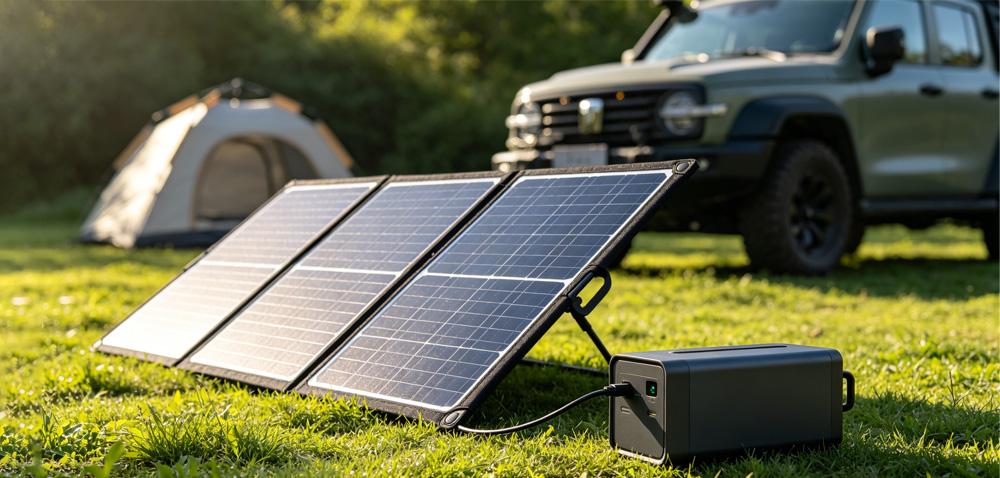
Foldable solar panels have become a popular choice for campers, overlanders, and anyone looking for flexible off-grid power. They promise portability, easy setup, and reliable charging in outdoor environments. But whether they are actually a good long-term solution depends on how they are used and what expectations are set.
Core Takeaways
- Foldable solar panels are designed for portability and fast deployment, making them ideal for camping and travel.
- Performance is generally strong in direct sunlight, but efficiency depends heavily on positioning and weather conditions.
- Durability varies by build quality, with hinges and fabric backing being the most common wear points.
- They are more flexible than rigid panels but usually less efficient for permanent installations.
- They work best as a mobile charging solution paired with a portable power station.
- Proper care and storage significantly extend their lifespan.
What Are Foldable Solar Panels?
Foldable solar panels are portable photovoltaic systems designed with hinged sections or fabric-based layouts that allow the panel to be folded into a compact form. Unlike rigid solar panels, they are built for mobility rather than fixed installation.
Most models are used alongside portable power stations, especially in camping or emergency backup scenarios. Users typically unfold the panel during daylight hours, position it toward the sun, and connect it to a battery system for energy storage.
Their design philosophy focuses heavily on convenience: providing a lightweight structure, easy setup, and compact storage for transport.
How Foldable Solar Panels Perform in Real Use
Performance is one of the most discussed aspects of foldable solar panels. In optimal sunlight conditions, many modern panels can deliver power outputs close to their rated capacity. However, real-world performance depends on several environmental factors.
Sun angle is one of the most critical variables. Because foldable panels are often placed directly on the ground or leaned against surfaces, they require frequent adjustments to maintain peak efficiency. Cloud cover and shading also reduce output significantly.
According to outdoor gear testing and user reviews from camping-focused sources, portable solar setups perform best when actively repositioned throughout the day rather than left static.
Real-world feedback from off-grid users highlights that foldable panels reliably charge batteries for small appliances—such as lights, phones, and portable fridges—when conditions are favorable. Overall, performance is strong for portable needs, but consistency depends heavily on user setup and weather.
Efficiency Compared to Fixed Solar Systems
Foldable panels are generally less efficient than fixed rigid systems when evaluated over long periods. This is not because the solar cells themselves are weaker, but because installation conditions are inherently less stable.
| Panel Type | Installation & Performance Characteristics |
|---|---|
| Rigid Panels | Typically mounted at fixed angles optimized for maximum sun exposure, providing more stable and consistent daily energy production, especially in stationary environments. |
| Foldable Panels | Often placed temporarily on uneven ground or tent surfaces, which can reduce optimal alignment and lead to less consistent energy output. |
However, foldable systems still offer a major advantage in mobility, making them far more practical for travelers and campers who move frequently.
Durability and Long-Term Outdoor Use
Durability is where foldable solar panels demonstrate both distinct strengths and limitations.
On the positive side, most foldable panels are engineered with weather-resistant coatings, reinforced stitching, and protective layers to handle outdoor exposure. They can comfortably withstand typical camping conditions such as dust, light rain, and occasional rough handling.
However, long-term durability is often limited by mechanical components. Hinges, folding seams, and fabric backings are more vulnerable to wear compared to rigid aluminum-framed panels. Repeated folding and unfolding over time can gradually reduce structural integrity.
User feedback across portable power communities suggests that careful storage and avoiding prolonged exposure to harsh weather significantly extend their lifespan. In general, they are highly durable for regular outdoor use but are not designed for permanent installation or extreme long-term exposure.
Camping and Outdoor Applications
Foldable solar panels are exceptionally popular in camping, overlanding, and RV travel. Their portability makes them easy to carry and deploy in remote locations where grid power is completely unavailable.
For campers, they are often paired with portable power stations to run essential devices such as:
- Portable refrigerators and coolers
- LED lighting systems
- Smartphones, cameras, and drones
- Small cooking or ventilation equipment
Their biggest advantage in outdoor settings is adaptability. They can be moved throughout the day to follow the sunlight and packed away quickly when not in use. Outdoor gear testing communities consistently rank them as one of the most practical energy options for camping setups.
Foldable vs Rigid Solar Panels
Choosing between foldable and rigid solar panels depends largely on your specific use case.
| Panel Type | Best Suited For |
|---|---|
| Foldable Panels | Frequent travel or camping, temporary setups, limited storage space, and situations requiring lightweight portability. |
| Rigid Panels | Permanent rooftop installations, higher long-term energy efficiency, stable environmental conditions, and minimal maintenance setups. |
Foldable systems prioritize convenience, while rigid systems prioritize efficiency and long-term output stability. Neither option is universally better; they serve completely different needs.
Limitations to Consider
While foldable solar panels offer strong convenience, they come with a few limitations that should be considered before purchase:
- Dependency on environmental conditions: Since they are often ground-mounted, they are easily affected by shading, dust, and suboptimal angles.
- Energy output consistency: Portable panels may produce fluctuating energy levels throughout the day as sunlight conditions and placement change.
- Mechanical wear: Mechanical stress from repeated folding can gradually reduce performance over time, particularly in lower-quality models.
Despite these drawbacks, many users still find them highly effective and indispensable for off-grid and recreational use.
Choosing the Right Foldable Solar Panel
Selecting a suitable foldable solar panel involves balancing power output, weight, and build quality.
| Consideration | Characteristics |
|---|---|
| Higher Wattage Models | Provide faster charging capabilities but are usually heavier and bulkier, making them slightly less portable. |
| Lightweight Panels | Much easier to transport and handle, but may require more time to fully charge power stations or devices. |
| Power Station Compatibility | Crucial to ensure the panel matches voltage requirements and connector types, as not all systems are universally compatible. |
Durability features such as reinforced stitching, waterproof ratings (like ETFE coatings), and sturdy protective cases can significantly impact long-term satisfaction.
Maintenance Tips for Better Performance
Proper care helps extend both the performance and lifespan of your investment.
- Keep them clean: Dirt directly blocks energy absorption, especially in dusty outdoor environments. Wiping the surface gently with a soft, damp cloth prevents buildup.
- Handle with care: Avoiding sharp folding angles, stepping on the panels, or placing heavy objects on top of them reduces mechanical stress.
- Store properly: It is highly beneficial to keep panels dry and stored in protective cases when not in use, even if they are rated as water-resistant.
Conclusion
Foldable solar panels are a portable and flexible power solution widely used for camping, travel, and off-grid situations. They perform excellently in direct sunlight and can reliably charge devices or portable power stations when properly positioned and maintained.
Compared to rigid solar panels, they are vastly easier to carry and set up, though their energy output is more affected by weather and placement. While not designed for permanent installations, they offer a highly practical balance of convenience and performance for mobile outdoor power needs.
At Xmnewlight, we create premium foldable solar panels that keep your adventures powered anywhere. Explore our solutions and make camping energy simple and reliable.
FAQ
Q1 Are foldable solar panels worth it?
Yes, they are highly worth it for camping, travel, and emergency backup power. They offer strong portability and convenience, though they are not ideal for permanent home installations.
Q2 How long do foldable solar panels last?
With proper care, many foldable panels can last several years. Lifespan depends heavily on usage frequency, storage conditions, and build quality.
Q3 Can foldable solar panels charge a fridge?
Yes, but performance depends on the panel’s wattage, sunlight conditions, and battery storage. Many users successfully run portable camping fridges using foldable panels paired with lithium power stations.
Q4 Do foldable solar panels work in cloudy weather?
They still produce energy in cloudy conditions, but the overall output is significantly reduced compared to operating in direct sunlight.
Q5 What is better, foldable or rigid solar panels?
Foldable panels are better for mobility, travel, and camping, while rigid panels are the superior choice for long-term, stationary installations requiring higher efficiency.


