People may choose to remove or replace their solar panels for several practical reasons, though this is not a widespread trend. Below are the key motivations:
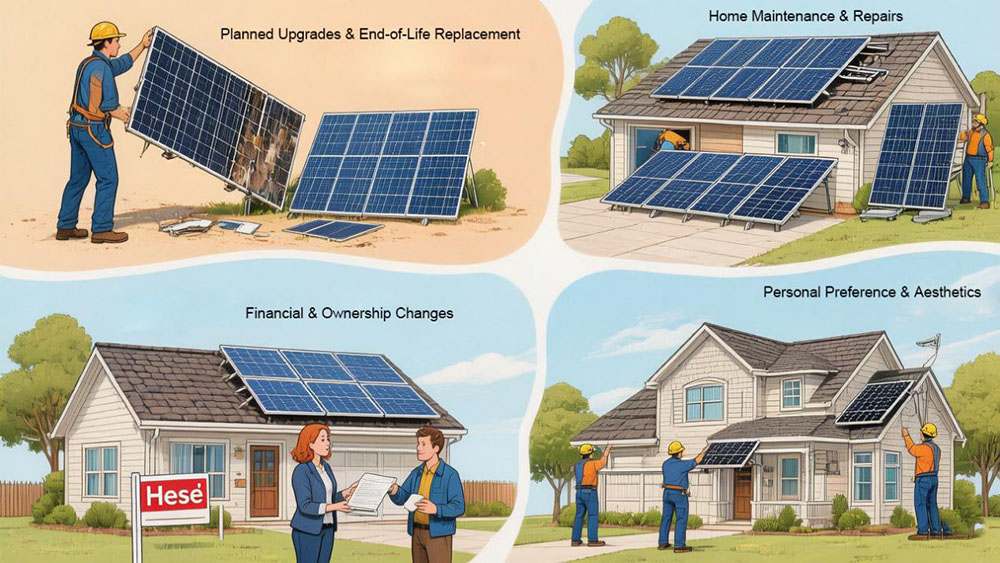
1) Planned Upgrades & End-of-Life Replacement
Aging/Efficiency Decline: Solar panels degrade over time (25–30 year lifespan). After this, output may drop below usefulness, prompting replacement.
Technological Advances: Newer panels offer higher efficiency, lower costs, or better aesthetics, motivating upgrades for improved performance.
2) Home Maintenance & Repairs
Roof Work: The most common reason. To repair/replace a roof, panels mustbe professionally removed. High removal/reinstallation costs sometimes lead homeowners to skip reinstalling them.
Physical Damage: Severe weather (hail, hurricanes), falling debris, or accidents can crack panels, requiring replacement.
3) Financial & Ownership Changes
Leased Systems/PPAs: Many homeowners lease panels or use Power Purchase Agreements (PPAs). Selling the home requires the new owner to accept the contract—if refused, panels are removed. Orphan systems (a leasing company bankrupted) also complicate ownership.
Policy Shifts: Reduced tax credits, rebates, or net metering benefits may make the system less financially viable.
Selling the Home: New owners might reject the system or its contract, leaving panels behind.
4) Personal Preference & Aesthetics
Appearance: Some dislike the look of panels on roofs (especially in historic districts with restrictions).
Relocation: Panels are permanently attached—they cannot be moved when selling/buying a new home.
Removing solar panels does not mean abandoning solar
Solar panels are a long-term asset, but their removal is frequently tied to practical adjustments that ultimately keep users connected to renewable energy. Here’s how:
1) Upgrading to Better Solar Technology
When homeowners remove old panels (e.g., after 10–15 years), it’s often to install newer, more efficient models. Modern panels generate more power per square foot, cost less, and may have better aesthetics. This “removal” is actually an upgrade—a way to maximize solar benefits, not abandon them.
2) Temporary Removal for Home Repairs
The most common reason for removal is roof maintenance or replacement. Panels must be taken down to access the roof, but they are almost always reinstalled afterwards. In rare cases where reinstallation is skipped, it’s often due to cost or logistical hurdles—not a rejection of solar energy itself.
3) Adapting to Life Changes
Selling a home: If the new owner declines a leased system (PPA) or prefers a different setup, the old panels may be removed. However, the seller could later install a new system in their next home.
Relocating: Panels are permanent fixtures, but movers often invest in new solar systems at their new residence.
4) Shifting to Alternative Solar Solutions
If roof panels are removed (e.g., due to damage or aesthetic preferences), users may switch to:
Ground-mounted solar arrays (for homes with yard space).
Community solar gardens (subscribing to shared local solar farms).
Portable solar devices (for RVs, cabins, or off-grid needs).
5) Recycling and Sustainability
Even when panels are decommissioned, they are rarely “abandoned.” Many components (aluminum frames, glass, copper wiring) are recyclable, and old panels can be repurposed for low-power applications. This aligns with the broader goal of sustainable energy use.
Stay updated on solar news
Subscribe to our newsletter and be the first to receive news about our latest developments in solar power.
Limitations of traditional rooftop solar panels
Traditional rooftop solar panels (typically referring to rigid silicon-based photovoltaic panels, the most common glass-encapsulated, aluminium-framed panels) are the mainstream choice for residential and commercial PV systems. However, their design and installation characteristics also bring some inherent limitations.
These limitations are not “defects” but may affect applicability or economy in specific scenarios. Below are their main limitations:
Physical and Installation Limitations
1) Weight and Roof Load Pressure
Rigid panels are relatively heavy (about 15–20 kg/m²). Old houses, lightweight roofs (e.g., wooden structures, tin roofs), or roofs with insufficient load-bearing capacity may not support direct installation. Structural reinforcement (e.g., adding beams) is required, increasing upfront costs and engineering complexity.
2) Space Occupancy and Layout Constraints
Although more efficient than flexible panels (18–22%), they still require sufficient continuous roof area. If the roof has skylights, chimneys, vents, trees, or neighboring building obstructions, the available installation area will be reduced. Small households or complex roofs (e.g., multi-slope attics) may not meet power demand.
3) Sensitivity to Roof Angle and Orientation
The optimal power generation efficiency of traditional panels depends on orientation (south-facing preferred) and tilt angle (usually consistent with local latitude). If the roof itself has a steep slope (e.g., steep-pitched roofs), deviates from south-facing (e.g., east-west), or is uneven (e.g., curved roofs), power generation will decrease significantly—unless adjustable brackets are added (further increasing costs and wind resistance).
Performance and Efficiency Limitations
1) Poor Shadow Tolerance
Traditional panels mostly use a “series string” design. When a single cell or part of a panel is shaded (e.g., by leaves, bird droppings, antennas), the current of the entire string drops sharply (“short-board effect”), resulting in a 30%–70% loss of power generation. In contrast, some flexible panels or new designs with “bypass diodes” can mitigate this issue, but traditional panels are more sensitive.
2) Temperature Dependence
Although rigid panels are more heat-resistant than flexible ones, the efficiency of semiconductor materials (silicon) still decreases with rising temperature (about 0.3%–0.5% per 1°C increase). In summer heat or direct sunlight, actual power generation may be 10%–20% lower than the nominal value.
3) No Power Generation Without Light
Inherently dependent on sunlight, they cannot generate electricity at night, on cloudy/rainy days, or in winter with insufficient light. Energy storage batteries (increasing costs) or grid power are required, making complete off-grid operation impossible.
Maintenance and Durability Issues
1) Cleaning and Maintenance Requirements
The glass surface easily accumulates dust, bird droppings, leaves, or snow. Long-term lack of cleaning reduces efficiency (dust shading can reduce power generation by 5%–15%, worse in dry/dusty areas). Cleaning requires manual or professional equipment, with safety risks for high-rise roofs.
2) Extreme Weather Risks
Although meeting hail resistance standards (usually withstanding 25mm-diameter hail at 23m/s), extreme weather (e.g., tornadoes, typhoons, severe hail) can still damage glass or frames. Salt spray corrosion in coastal areas may accelerate aluminium frame aging.
3) Immovability
Once installed, panels are permanently fixed to the roof. If the homeowner moves, they cannot take the panels (removal costs may be 30%–50% of initial installation) and can only leave them for the new owner or transfer them at a low price, far less flexible than portable or flexible panels.
Cost and Economic Limitations
1) High Initial Investment
Including panels, inverters, brackets, labor, and grid connection approval, the total cost is usually 2,000–3,000 USD/KW (for domestic), which is a barrier for budget-limited families. Although long-term electricity savings are available, the payback period is 5–10 years (dependent on electricity prices and policy subsidies).
2) High Costs for Removal and Reinstallation
If the roof needs repair or replacement (the most common reason for removal), panels must be professionally removed (to avoid roof damage). The reinstallation cost after repair may account for 20%–40% of the initial investment. If reinstallation is abandoned, the upfront investment becomes a “sunk cost.”
3) Dependence on Policy and Market Fluctuations
Economy highly relies on government subsidies (e.g., tax credits, feed-in tariffs) and grid “net metering policies” (allowing selling excess power to the grid). If policies are scaled back (e.g., reduced subsidies, lower feed-in prices), the payback period will extend, even affecting investment value.
Aesthetic and Regulatory Constraints
1) Aesthetic Controversies
Some homeowners believe the “industrial feel” of traditional panels ruins the original aesthetics of their homes (especially historic buildings, high-end residences, or design-focused communities), which may cause neighborhood disputes or violate homeowners’ association (HOA) rules.
2) Building Code Restrictions
Some areas have strict regulations on the installation height, area ratio, and fire rating of rooftop PV (e.g., banning installation in historic preservation areas or requiring panels to be flush with the roof), limiting installation options.
Other Considerations
Slow Technological Iteration: Traditional panel technology is mature but updates slowly. If higher-efficiency new products emerge a few years after installation, upgrading requires replacing the entire system rather than partial optimization.
Grid Compatibility: In old residential areas with insufficient grid capacity, large-scale panel grid connection may cause voltage fluctuations, requiring additional voltage stabilization equipment.
More Light weight solar energy solutions From NEWLIGHT ENERGY