


News
Solar Panels Complete Overview
News | Sep 15,2025
Solar photovoltaic (PV) technology has advanced rapidly over recent decades. It now offers multiple panel types designed for different applications, budgets, and performance needs. Solar energy is abundant, and the energy from one minute of sunlight far exceeds global annual consumption.
To harness this effectively, businesses must choose the right solar panel type. This article examines the key solar panel types such as monocrystalline, polycrystalline, PERC, thin-film, and flexible panels.
It emphasizes construction, efficiency, costs, and applications, while also noting emerging technologies that matter to industry decision-makers.
Monocrystalline (Mono-Si) Solar Panels
Monocrystalline solar panels are made from single-crystal silicon ingots. The ingots are sliced into wafers with a uniform crystal structure. Because of this purity, mono panels have high efficiency, typically 20–22% in practice with top models reaching about 23%.
For example, the latest high-end mono panels can exceed 25% efficiency. This translates to more power output per unit area.
They are ideal where space is limited, such as rooftop or commercial sites. The cells have a distinctive uniform black appearance and are framed with tempered glass and metal for durability.
Monocrystalline panels offer long lifespans of over 25 years and strong warranties, reflecting their premium performance. However, their manufacturing is resource-intensive, wasting up to half of the silicon.
Typical costs are on the higher end, around $300–$600 per panel for consumer models. Economies of scale and bulk procurement can lower prices for large projects.
Despite a higher upfront cost, mono panels often provide better return on investment through greater energy yield over time.

Key attributes of monocrystalline panels:
- Efficiency: ~20–23% (industry-leading). Newer high-performance models can exceed 23%, with laboratory and premium commercial designs targeting 24% and above.
- Cost: High ($300–$600 per panel).
- Lifespan: ~25–30 years.
- Advantages: Highest output per area, sleek all-black appearance, best for space-constrained installations.
- Disadvantages: More expensive, energy-intensive production with higher silicon waste.
Mono panels are widely used in residential, commercial, and utility-scale projects where efficiency justifies the cost.
Polycrystalline (Multi-Si) Solar Panels
Polycrystalline solar panels are made by melting multiple silicon crystals together in a mold. Their structure is less uniform than mono panels and gives them a blue-speckled look.
The production process is simpler and cheaper because molten silicon is poured into square molds with less waste. As a result, poly panels usually cost $100–$300 per panel, much cheaper than mono. They are attractive for bulk orders or cost-sensitive projects.
The lower cost comes with trade-offs. Polycrystalline cells have more grain boundaries, which block electron flow and reduce efficiency.
They usually convert only 15–17% of sunlight into electricity. They also perform less well in high heat and have a shorter lifespan than mono.
In practice, most modern poly panels produce 240–300 W for a 60-cell panel, while similar mono panels often exceed 300 W. This means poly panels need more space to deliver the same output.
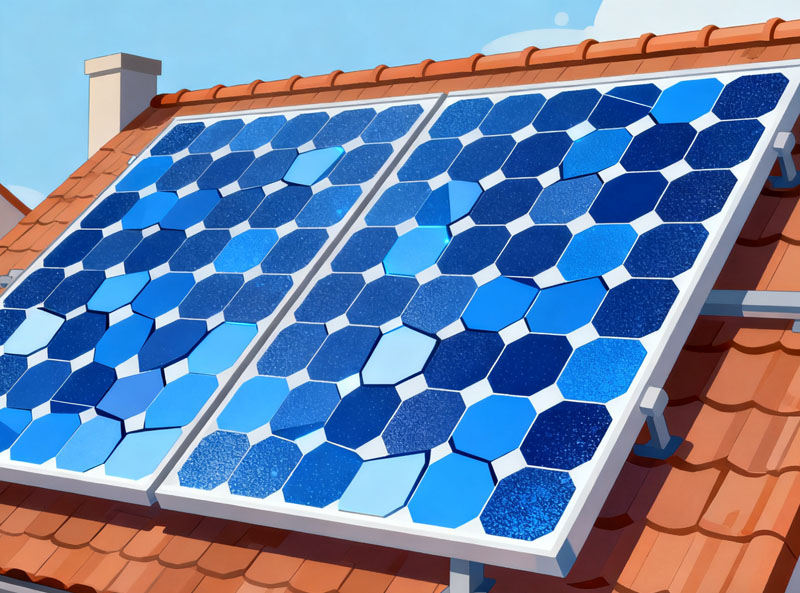
Key attributes of polycrystalline panels:
- Efficiency: ~15–17% (lower than mono).
- Cost: Lower ($100–$300 per panel).
- Lifespan: ~20–25 years (typically shorter than mono).
- Advantages: Cheaper upfront, less material waste in production, widely available in large sizes (ideal for utility and commercial arrays).
- Disadvantages: Lower power density, blue mottled look (less aesthetic), slightly lower longevity.
Polycrystalline panels remain popular for large ground-mounted or commercial projects where roof space is ample and cost per watt is a priority.
For example, many solar farms use poly panels to minimize capital expense per megawatt. In markets where polycrystalline production is phased out, panels may be legacy or second-hand, so ensure quality.
Advanced Silicon Technologies: PERC and More
Recent innovations in silicon PV technology yield panels that boost efficiency beyond standard mono/poly. PERC (Passivated Emitter and Rear Contact) is one such advancement.
PERC solar cells add a dielectric passivation layer (usually silicon nitride) on the cell’s rear surface. This passivation reflects unabsorbed photons back into the cell and reduces electron recombination, enabling 5–15% higher efficiency especially under low-light or high-temperature conditions.
PERC cells can be built on either mono- or poly-crystalline wafers, so you may see “Mono PERC” or “Poly PERC” modules. The extra manufacturing steps make PERC modules slightly more expensive than non-PERC, but the efficiency gain often justifies the cost.
Beyond PERC, two other cutting-edge silicon-cell types are worth noting:
- Heterojunction (HJT) cells: Combine thin amorphous silicon layers with crystalline wafers, achieving ~22–24% efficiency in commercial panels. HJT panels typically command a premium but offer high efficiency and good performance in low light.
- TOPCon (Tunnel Oxide Passivated Contact): Similar in concept to PERC but with different passivation/tunneling layers, yielding efficiency akin to PERC/HJT.
As an example, bifacial PERC modules (monocrystalline cells on double-glass) can harness light from both sides to further increase output. In fact, PERC/bifacial mono panels are currently among the most efficient commercially available (often >22%).

Advanced silicon panel highlights:
- PERC: Rear-surface passivation, +5–15% efficiency boost; low additional cost.
- HJT: Highest crystalline efficiency (~22–24%), excellent low-light performance; higher cost.
- TOPCon: Next-gen passivation layer, similar efficiency gains as PERC.
- Bifacial: Can capture reflected light on the rear side, raising total yield by 5–15% in real installations.
- Application: Premium projects, trackers, high-performance builds.
When designing a solar array, consider whether advanced panels (like PERC or bifacial) can deliver better ROI, especially in challenging environments.
Thin-Film Solar Panels
Thin-film solar panels use very thin layers of photovoltaic material deposited on a substrate (glass, plastic, or metal). They come in several chemistries, the most common being:
- Amorphous Silicon (a-Si): Non-crystalline silicon.
- Cadmium Telluride (CdTe): A compound thin-film.
- Copper Indium Gallium Selenide (CIGS): A high-efficiency compound film.
Thin-film modules are about 350 times thinner than conventional silicon cells. This makes them lightweight, low-profile, and often flexible.
They can be produced on lightweight or flexible materials (plastic sheets or stainless foil), allowing semi-flexible panels. Thin-film panels also have uniform appearance and can be made in custom shapes.
However, the trade-off is lower efficiency. Most thin-film panels convert only around 7–12% of sunlight, although some modern CIGS modules exceed 15%. In practice, a typical thin-film panel may need up to 2–3 times the area of a mono panel for the same power output.
They also tend to have shorter warranties (10–20 years) and faster degradation. On the upside, thin-film performs relatively better in diffused light and high temperatures, and production costs per square meter can be low.
Key attributes of thin-film panels:
- Efficiency: Generally 7–12% (some CIGS ~15–18%).
- Form factor: Thin, low weight, can be flexible or semi-flexible. Available in large panel formats.
- Cost: Often low cost per unit area, but cost per watt can be higher due to low output.
- Advantages: Versatile applications (e.g. on curved surfaces, integrated facades). Lower cost for large industrial installations.
- Disadvantages: Lower power density, larger space needed, typically shorter life.
Thin-film panels suit scenarios where area is not limited and specialized form factors are needed. For example, building-integrated photovoltaics (BIPV) often use thin-film or even transparent thin-film, such as solar windows or roof tiles.
Large-scale ground or rooftop solar farms (e.g. First Solar’s CdTe installations) exploit thin-film’s low cost per area. Portable, mobile, or off-grid panels also often use thin-film a-Si or CIGS for weight savings.
Flexible Solar Panels
Flexible solar panels are a specialized subset of thin-film technology designed for portability and installation on irregular surfaces. They use ultra-thin photovoltaic materials laminated on bendable substrates.
Flexible panels may use amorphous silicon, CIGS, or very thin crystalline silicon cells attached to plastic or metal foils.
This construction allows the panel to bend or flex up to about 30° for crystalline-based flex panels and nearly rollable for CIGS thin-film, without cracking.
The main advantages of flexible panels are their lightweight and versatility. They can weigh as little as a few pounds for a 100W panel, compared to ~20–25 kg for a rigid glass panel.
Installation is often as simple as peeling and sticking or using rivets, and no heavy mounts or trays are needed.
This makes them ideal for curved vehicle roofs such as RVs, boats, and aircraft, as well as tent and backpack systems or emergency deployment.
They are also used in BIPV, for instance solar membranes on building facades or wearable solar products.
However, flexible panels sacrifice efficiency and lifespan for mobility. Their conversion efficiencies typically range 10–18%, which is lower than rigid mono/poly.
Advanced flexible models (thin mono cells) can reach ~18%, but most a-Si or older CIGS flex panels are under 15%.
They also tend to have shorter warranties (often 5–10 years) due to vulnerability of plastic components. As of 2025, flexible modules cost significantly more per watt than rigid panels.

Key features of flexible solar panels:
Construction: Ultra-thin cells on plastic or metal foil. Common materials include a-Si, CIGS, and recently even thin mono cells with protective coatings.
Form factor: Bendable, rollable, or foldable. Some can be rolled up for transport.
Efficiency: About 10–18%. Lower than rigid counterparts (mono/polys at ~17–22%).
Weight: Very light (often <3 kg for 100W), easing mounting on any surface.
Advantages: Portable and versatile – mount on curved or moving surfaces, easy DIY installation, good for mobile/off-grid uses. Weather-resistant plastics make many models shock- and water-resistant for outdoor use.
Disadvantages: Lower output (needs more panels to meet big demands), shorter lifespan (plastic degrades faster), higher cost per watt.
Applications: Remote power kits, boat and RV systems, emergency/disaster relief, and consumer products (e.g. laptop chargers).
For example, disaster relief teams and military units use flexible panels for quick-deploy kits. We supply flexible monocrystalline and CIGS panels (e.g. 100–300W) with MC4 connectors, ideally paired with portable power stations or batteries.
These are perfect for solar field-testing, off-grid cabins, or any project requiring lightweight modular power.
Emerging and Specialized Solar Technologies
Beyond the main panel types, there are several newer options worth noting:
Bifacial Panels
These panels generate power on both sides using transparent glass and reflective light from the ground. In good conditions, they can increase energy output by 5–15%.
Most are built on monocrystalline cells with PERC or advanced coatings. They are now common in commercial and utility projects.
Building-Integrated PV (BIPV)
Here, solar cells are built directly into materials like roof tiles, facades, or windows. Glass-based CIGS or perovskite films are typical choices, creating solutions that combine aesthetics with energy production.
Concentrated PV (CPV)
These systems use lenses or mirrors to focus sunlight on high-efficiency multi-junction cells that can reach lab results above 40%. They need sun-tracking and cooling systems, so they are mostly used in desert or high-sun areas.
Perovskite Solar Cells
A fast-growing area of research. Lab tests have already reached efficiencies above 30%. Perovskite panels are expected to be cheaper to make, with potential flexibility and high performance. They are not yet mass-market but could play a big role soon.
Organic and Dye-Sensitised Cells
These third-generation cells are extremely thin and flexible. At present, their efficiency is still low, usually in the single digits, and their lifespans are short. Research continues to improve them.
Each of these options has clear strengths and weaknesses. Some, like bifacial or PERC panels, are already extensions of mainstream crystalline technology and available from us. Others, like perovskite or organic panels, are still in development.
Which Type of Solar Panel Is Best?
Choosing the best solar panel depends on the specific needs of a project. Factors such as budget, space availability, efficiency goals, and application type all influence the decision.
Monocrystalline panels are preferred when maximum efficiency and long-term ROI are priorities. Polycrystalline panels are suitable for large projects where keeping upfront costs low is critical.
Thin-film and flexible panels are practical for lightweight, portable, or integrated solutions. Newer technologies like bifacial or perovskite panels may be the right choice for projects focused on innovation and advanced performance.
Comparison Table: Which Panel Type Fits Best
| Panel Type | Best For | Why |
| Monocrystalline | Premium rooftops, high-value commercial projects | Highest efficiency and power density, strong ROI over time |
| Polycrystalline | Large-scale, cost-sensitive projects | Lower cost per panel, attractive for bulk procurement |
| PERC / Advanced Silicon | High-performance systems | Better low-light and heat performance, higher overall efficiency |
| Thin-Film | BIPV, large surfaces, industrial roofs | Lightweight, adaptable form factor, works in diffused light |
| Flexible | Mobile, curved, or temporary uses | Portable, light, easy to install, good for RVs, boats, disaster kits |
| Bifacial | Utility-scale farms, trackers | Extra energy from both sides, strong yield on reflective ground |
| Perovskite / Emerging | Pilot projects, innovation-driven applications | Potential for high efficiency and lower costs, still developing |
Final Recommendation
Every project has unique requirements, and selecting the right solar panel type can make a significant difference in performance and ROI.
Our company provides a full range of solutions from monocrystalline and polycrystalline to advanced PERC, thin-film, and flexible modules.
If you are planning a commercial, industrial, or specialized solar application, our team NEWLIGHT ENERGY can recommend the best option for your goals.
Contact us today to receive tailored advice, detailed product specifications, and competitive quotes for your next project.
--- END ---


